My idea is that I would be able to do an ARToolkit based visualization performance by using a clear table with markers I can slide, rotate, add and remove, and all those movement could correspond to events on screen. Unlike other AR videos the source video wouldn't be incorporated into the output necessarily, the markers provide an almost infinitely expressive set of UI knobs and sliders.
So far I have this:
AR User Interface from binarymillenium on Vimeo.
The lighting is difficult, the markers need to be white and black pixels but the plexiglass tends to produce reflections. Also if the light source itself is visible a marker will not be able to be right on top of it. I need a completely black backdrop under the plexiglass so there are no reflections that will obscure the markers, and also more numerous and softer diffuse lights.
One way to solve the reflection problem is to have the camera looking down at a table, though it's a little harder to get the camera up high enough, and I didn't want my hands or body to obscure the markers- the clear table idea is more elegant and self-contained.
The frame rate isn't very high, I need to work on making it all more real-time and responsive. It may have to be that one computer is capturing video and finding marker positions and sending them to another computer completely free to visualize it. Also more interpolation and position prediction could smooth things out, and cover up gaps if a marker isn't recognized in a frame, but that could produce more lag.
Showing posts with label artoolkit. Show all posts
Showing posts with label artoolkit. Show all posts

2008-11-20
Artoolkit + rangefinder
Since my relatively inexpensive purely visual depth map approach wasn't that successful, I've tried it out using a rangefinder instead of a visible laser. This means I can point the video camera straight at the marker (which is attached to the rangefinder), and it can point at anything provided I don't tilt it so the camera can't see the marker/fiducial.
This is the result:
Artoolkit with a Rangefinder from binarymillenium on Vimeo.
The following plots show the tracked attitude of the rangefinder as measured by ARToolkit:


My left to right bottom to top scanning approach is very apparent.
And here is the tracked attitude (as a 3-component vector) plus the range vs. time:

You can see how cyclical it is, as I scan the floor in front of me the range doesn't change much until I reach one end and tilt the tripod up a little, and then later on I start to capture the two wheels of the car.
This is the result:
Artoolkit with a Rangefinder from binarymillenium on Vimeo.
The following plots show the tracked attitude of the rangefinder as measured by ARToolkit:
My left to right bottom to top scanning approach is very apparent.
And here is the tracked attitude (as a 3-component vector) plus the range vs. time:
You can see how cyclical it is, as I scan the floor in front of me the range doesn't change much until I reach one end and tilt the tripod up a little, and then later on I start to capture the two wheels of the car.
2008-10-07
Artoolkit rangefinding continued
I've discovered the arParamObserv2Ideal() function to correct for image distortion, and I think it has improved things. But my main problem is figuring out how to properly project the line from the origin through the laser dot in marker/fiducial space. I have a message out on the mailing list but it is not that active.
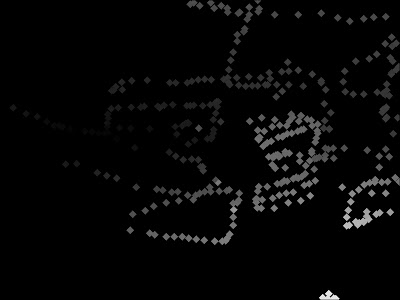
The results of my crude fillgaps processing app are shown below, using the somewhat sparse points from above.
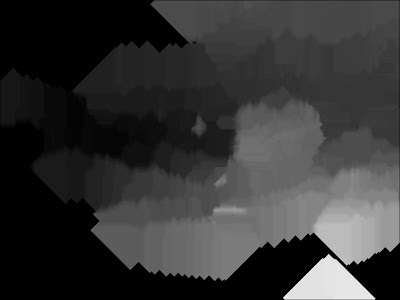
The above results look pretty good- the points along the edge of the wall and floor are the furthest from the camera so appear black, and the floor and wall toward the top and bottom of the image are closer and get brighter.
My main problem is getting live feedback of where I've gotten points. With a live view that showed all found depth points it would be easier to achieve uniform coverage, rather than going off of memory. My problem there is that to use artoolkit I have to detect the markers, then shrink the image down and draw dots over it- not too hard sounding but the first time I tried it got all messed up.
The results of my crude fillgaps processing app are shown below, using the somewhat sparse points from above.
The above results look pretty good- the points along the edge of the wall and floor are the furthest from the camera so appear black, and the floor and wall toward the top and bottom of the image are closer and get brighter.
My main problem is getting live feedback of where I've gotten points. With a live view that showed all found depth points it would be easier to achieve uniform coverage, rather than going off of memory. My problem there is that to use artoolkit I have to detect the markers, then shrink the image down and draw dots over it- not too hard sounding but the first time I tried it got all messed up.
2008-10-05
Depth Maps with ARToolkit and a Laser Pointer
Flying home from a recent trip to the east coast, I tried to figure out what the most inexpensive method for approximating scanning lidar would be. This is my answer:
ARToolKit assisted laser rangefinding from binarymillenium on Vimeo.
It's not that inexpensive, since I'm using a high resolution network camera similar to an Elphel- but it's possible I could replace it with a good consumer still camera with a linux supported usb interface for getting live images.
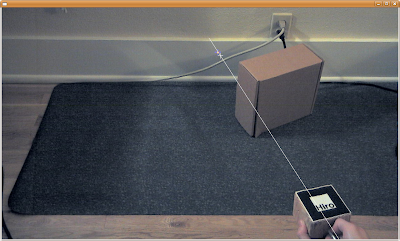
In the above screen shot the line projected from the found fiducial is shown, and the target where the found red laser dot is- they ought to cross each other but I need to learn more about transforming coordinates in and out of the camera space in ARToolkit to improve upon it.
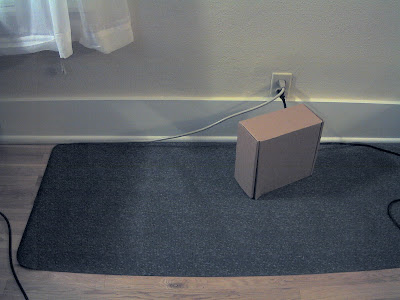
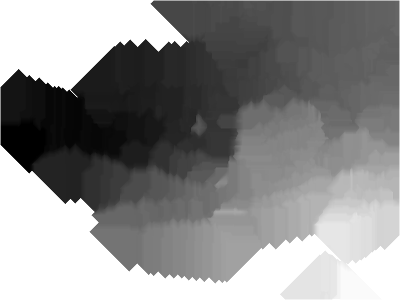
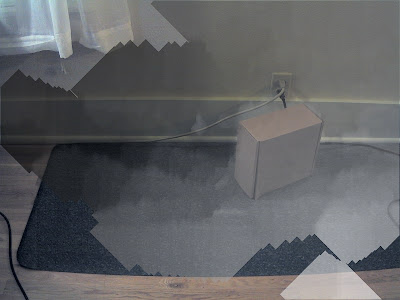
This picture shows that the left side of the screen is 'further' away than the wall on the right, but that is not quite right- it is definitely further away from the fiducial, so I may be making an error.
source code
ARToolKit assisted laser rangefinding from binarymillenium on Vimeo.
It's not that inexpensive, since I'm using a high resolution network camera similar to an Elphel- but it's possible I could replace it with a good consumer still camera with a linux supported usb interface for getting live images.
In the above screen shot the line projected from the found fiducial is shown, and the target where the found red laser dot is- they ought to cross each other but I need to learn more about transforming coordinates in and out of the camera space in ARToolkit to improve upon it.
This picture shows that the left side of the screen is 'further' away than the wall on the right, but that is not quite right- it is definitely further away from the fiducial, so I may be making an error.
source code
Subscribe to:
Posts (Atom)